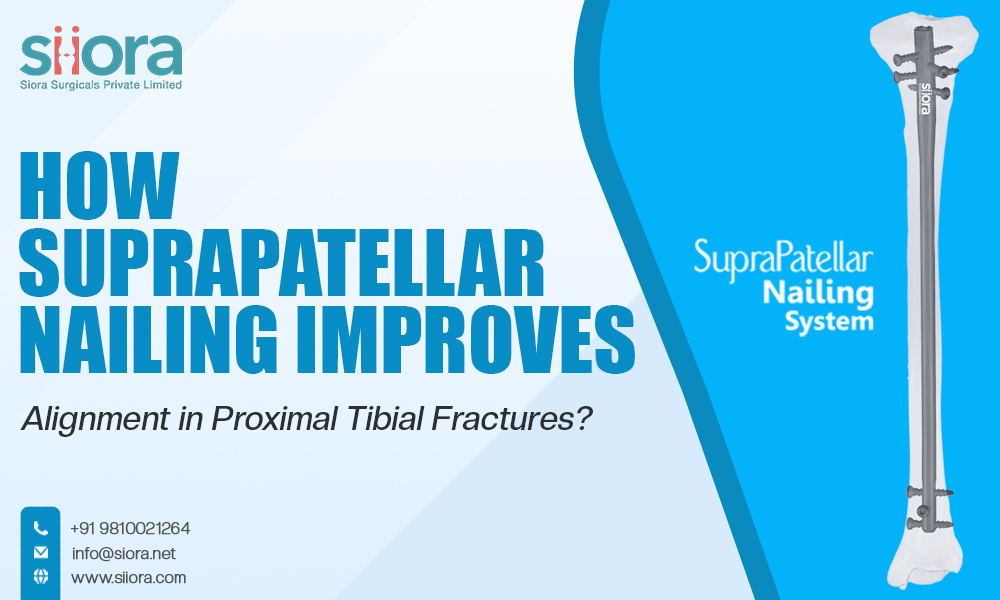
Suprapatellar nailing has flipped the script on proximal tibial fractures, making alignment a whole lot more reliable without the old portal’s quirks. These tricky breaks—right up near the knee joint—used to test even seasoned surgeons’ patience with malrotation or valgus drift sneaking in despite best efforts.
The Old Infrapatellar Nail Struggle
Classic intramedullary nailing went through the infrapatellar portal, splitting the fat pad and aiming the guidewire blindly from below the kneecap. Proximal tibial fractures complicate things: metaphyseal comminution, short segments, and joint proximity mean the nail fights to stay central. Off-axis entry often shoves the tip medial or anterior, baking in varus-valgus deformity or procurvatum that shows up on post-op films.
Reduction suffers too. Hammering a nail past unstable fragments risks losing articular alignment or driving the fracture into extension. Studies pegged malalignment over 5 degrees in 20-30% of cases, with reops for nonunion or deformity correction eating up time and trust.
Suprapatellar approach changes the game by starting above the patella, using knee flexion to drop the trochlea out of the way for a straighter shot down the medullary canal.
How Suprapatellar Entry Nails Alignment?
The portal sits safely in the suprapatellar recess, accessed through a 2-3cm incision proximal to the superior pole. With the knee flexed 90-110 degrees, the patella tilts naturally, exposing the trochlear groove for perpendicular guidewire placement. That means the nail glides dead-center through the canal, hugging the anatomic bow without eccentric reaming or toggling.
Proximal fractures benefit huge: the working angle lets surgeons visualize and joystick fragments directly under fluoro. A central nail acts like a pollster, pulling comminuted bits into length and rotation while blocking shear. Early data shows coronal alignment within 2 degrees in over 90% of cases—miles better than infrapatellar’s 70-80%.
Sagittal plane wins too. Suprapatellar nailing cuts procurvatum risk by entering parallel to the tibial plateau, avoiding the anterior lean that plagues bottom-up starts. No more fighting the patellar tendon tether.
Intraop Workflow That Feels Smooth
Day-to-day, it’s a breath of fresh air. Position the leg supine on a radiolucent table, flex the knee over a bolster, and drape wide. Incise, blunt dissect to the synovium, sleeve in, and wire under direct C-arm view—crystal clear AP and lateral without tilting the whole leg.
Reduction clamps or balloon tamp the metaphysis if needed, then ream progressively (usually 0.5mm over nail size). Nail insertion feels guided, not forced; proximal locking through oblong holes fine-tunes rotation before distal screws lock it down. Total time? Often 10-15 minutes are shaved off versus infrapatellar, with less soft-tissue trauma.
Patient Outcomes and Complication Drops
Patients see the payoff fast. Better alignment translates to smoother rehab: full weight bearing at 6 weeks, knee scores (Lysholm, IKDC) running 10-15 points higher at one year. Compartment risks dip—no patellar tendon irritation, lower anterior knee pain (under 5% vs 15-20%). Infection stays rare (<1%), and union hits 95% by 16 weeks, even in osteoporotic bone.
Suprapatellar shines in multifragmentary or open fractures (Gustilo II/III), where preserving joint congruity matters most. Elderly or diabetic patients—tough healers—get reliable stability without plating’s bulk.
When to Pick Suprapatellar Nailing?
Not every proximal tibia screams for it. Isolated shaft fractures or intact metaphyses do fine infrapatellar. But for AO/OTA 41 patterns with extension risk, comminution, or joint depression, suprapatellar delivers precision that slingshot starts can’t touch.
It’s pricier on consumables, sure, but offsets with fewer malunions and revisions. In busy trauma bays, that alignment edge means surgeons sleep better, patients walk sooner, and ortho clinics stay unclogged. Suprapatellar nailing isn’t just a portal swap—it’s smarter fracture control from entry to endpoint.
If you want to explore advanced orthopedic solutions and other cutting-edge healthcare products, book your visit to Arab Health 2026 (now WHX Dubai).
 Ortho Surgical Implants