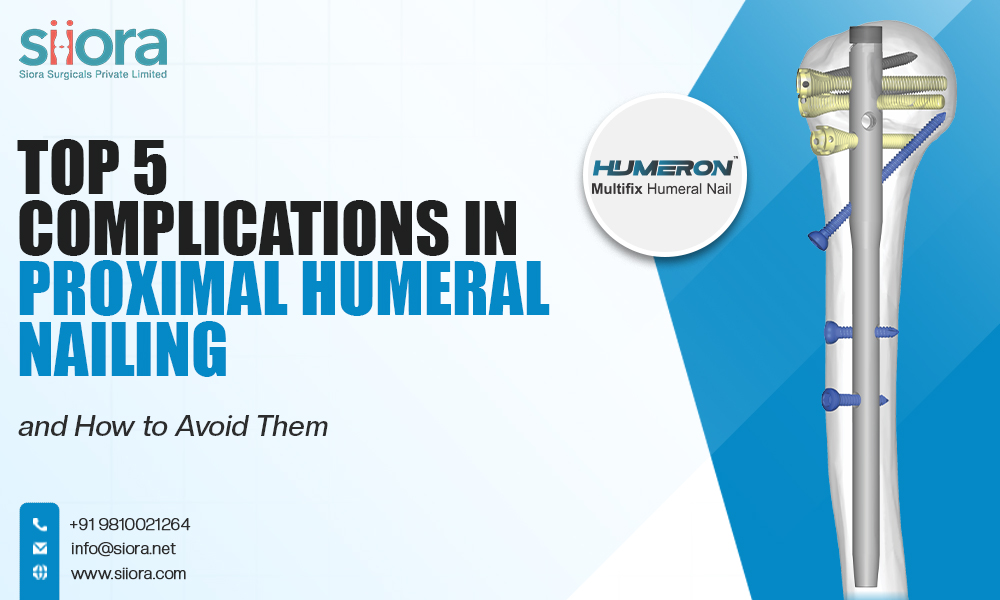
Proximal humeral nailing can give excellent results—but only if common pitfalls are avoided. Overall complication rates around 15–20% are reported, with roughly 7–8% fracture-related issues, 7% hardware problems, and smaller rates of soft-tissue or nerve complications. Here are the top 5 troublemakers and practical ways to stay out of their way.
1. Rotator Cuff Injury and Subacromial Impingement
Because most humeral nails are inserted antegrade, the entry point passes close to the supraspinatus footprint. Poorly chosen or oversized entry, or leaving the nail proud, can damage the cuff and cause chronic shoulder pain, weakness, and impingement.
How to avoid it:
- Use a superior, in-line, medial entry point that stays within the cuff footprint but as medial as safely possible; this reduces varus malunion and cuff trauma.
- Protect the cuff with a small split and meticulous repair at the end of the case.
- Countersink the nail just below the cartilage surface so it does not impinge under the acromion in elevation.
- Early supervised physiotherapy focusing on gentle elevation and rotation helps prevent stiffness once fixation is stable.
2. Loss of Reduction and Varus Malunion
Loss of reduction—often into varus—is one of the most frequent mechanical failures after proximal humeral nailing. Four-part fractures and patterns with medial calcar comminution are especially vulnerable, with reported complication rates exceeding 40–50% if medial support is not secured.
How to avoid it:
- Achieve anatomic or slight valgus reduction before nail insertion; avoid distracting the fracture while reaming.
- Restore medial support: use calcar-directed screws and secure the inferomedial region of the head whenever possible.
- Use multiple proximal locking screws in different planes to control rotation and prevent head tilt.
- Confirm reduction and head–shaft angle on true AP and scapular Y views before final locking; don’t rely on a single fluoroscopy plane.
3. Screw Penetration and Hardware Problems
Intra-articular screw penetration, screw back-out, and proximal screw protrusion are well-documented issues. Systematic reviews describe hardware complications in about 7–10% of humeral intramedullary nailing cases.
How to avoid it:
- Use appropriate screw length: stop 2–3 mm short of the subchondral bone and double-check in multiple views, including an external rotation view to unmask posterior penetration.
- Prefer modern nails with angularly stable proximal locking and guided targeting arms, which reduce the risk of eccentric screw placement.
- Reassess screw position at the end of surgery after final reduction and compression; adjust any borderline screw lengths before closing.
4. Nonunion and Delayed Union
While overall union rates after humeral nailing are high, nonunion or delayed union still occur in roughly 1–3% of cases. Risk increases with open fractures, severe comminution, distraction at the fracture site, smoking, and poor biology.
How to avoid it:
- Avoid distraction across the fracture when inserting and locking the nail—maintain or even slightly compress the site.
- Respect biology: minimize soft-tissue stripping, preserve periosteum and fracture hematoma, and consider bone graft or augmentation in atrophic or segmental patterns.
- Correct systemic factors: encourage smoking cessation, control diabetes, and optimize nutrition in the perioperative period.
- Use nails with compression capability or dynamization strategies in transverse/short-oblique shaft extensions when indicated.
5. Nerve Injury and Shoulder Stiffness
Radial nerve palsy and other nerve issues are more common with humeral shaft nailing but can also occur with proximal constructs, especially during distal locking or aggressive retraction. Stiffness is another frequent functional complication when mobilization is delayed or fixation is unstable.
How to avoid it:
- Plan distal locking carefully: know safe corridors and use gentle soft-tissue handling and accurate fluoroscopic targeting to avoid radial nerve and axillary nerve zones.
- Position the patient to allow full shoulder motion intraoperatively so the nail and screws can be placed without levering on soft tissues.
- Aim for stable fixation that tolerates early motion; start passive and assisted exercises as soon as pain and construct stability allow, avoiding prolonged immobilization in internal rotation which can lead to tuberosity malrotation.
Handled thoughtfully, proximal humeral nailing offers minimally invasive stabilization with good pain relief and function. Knowing these five common complications—and building habits to prevent them—turns a technically demanding procedure into a predictable, shoulder-saving option for many patients.
If you want to explore Siora’s latest orthopedic implants, including the advanced humeral nailing systems, visit WHX Dubai 2026.
 Ortho Surgical Implants